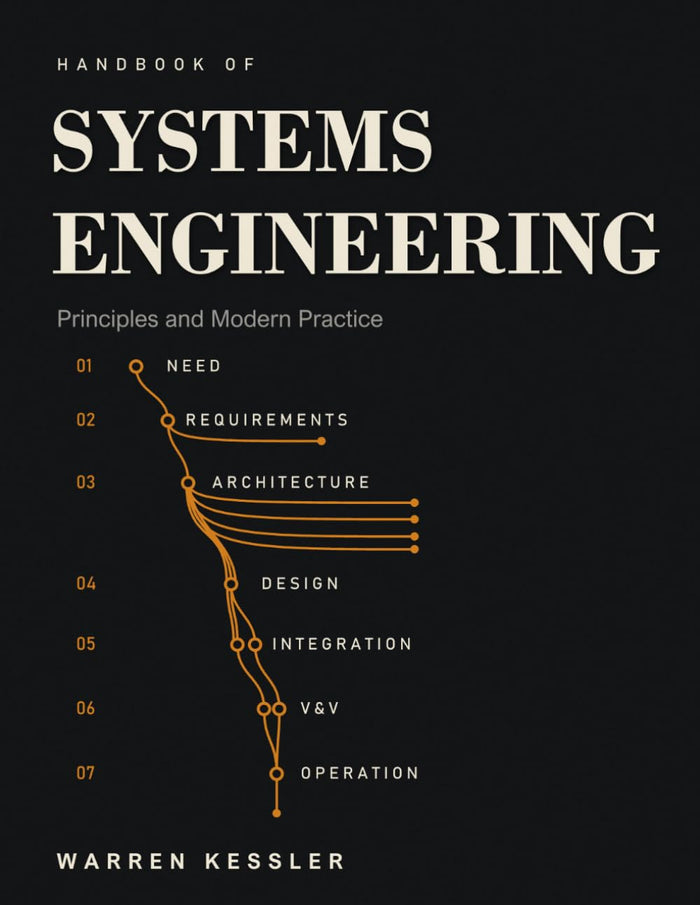
Every engineer on the team did competent, defensible work and the system still failed. If you have seen that pattern, or you are training to avoid it, this handbook was written for you.
Most systems engineering education teaches a sequence of named processes — elicit, decompose, allocate, verify — without explaining why a capable engineer doing each step correctly can still watch a program fail. Field guides collect hard-won lessons but skip the structured foundation a newcomer needs to apply them. The result is a costly gap: students who know the vocabulary but not the judgment, and practitioners who have the judgment but lack a dependable reference for the discipline behind it.
This handbook closes that gap from both directions at once. Across twenty-five chapters, it develops the full modern systems engineering life cycle — from stakeholder needs and concept studies through requirements, architecture, digital engineering practice, verification, production, and the long operational life that follows — and nearly every chapter opens with a realistic case in which individually sound engineering produced a failed system, then builds the specific discipline that would have prevented it.
Inside, you will learn to: Write well-formed, verifiable requirements and manage them across the full life cycle Build functional and physical architectures and defend allocation decisions in trade studies Apply model-based methods and modern digital engineering workflows with discipline Plan verification and validation with explicit traceability from need to test evidence Manage risk, reliability, and assurance using structured, reviewable techniques Carry a system through production, sustainment, and eventual disposal Scale the same discipline to systems of systems, enterprise portfolios, and security Each chapter follows the same dependable structure: an opening case, numbered procedures with verification checks, common failure patterns, paired case studies, worked examples, and practice problems with a full answer key. A consistent set of callout boxes: key terms, cautions, design tips, standards references — means a definition or self-check always appears in the same form, whichever chapter you open.
This book serves students meeting systems engineering for the first time and practicing engineers who need a specific procedure on a real deadline. Requirements engineers, systems architects, project and program engineers, and professionals moving into the discipline from adjacent fields will all find material pitched at their working reality.
Complex systems will not forgive informal engineering, however individually skilled. Get your copy and start building the structured, traceable practice that keeps competent work from becoming the next failure case study.
Book details
-
Full title: Handbook of Systems Engineering Principles And Modern Practice: A Comprehensive Guide to Requirements Analysis, Model-Based Systems Engineering, ... for Students and Practitioners — New Edition
-
Author: Warren Kessler
-
Publisher: Independently published
-
Format: Paperback
-
Pages: 581
-
Language: English
-
Publication date: August 10, 2026
-
ISBN: 9798191990811
Secure checkout · Fast dispatch · Need 100+ copies? Email us for a quote.